Prior authorization
Restored member agency in one of healthcare's most frustrating moments, giving patients clarity and a clear path forward for the first time.


Restored member agency in one of healthcare's most frustrating moments, giving patients clarity and a clear path forward for the first time.
"I hate prior authorizations. Stop getting in the way! Don't understand why it has to be this hard!"
What members of the pharmacy needed was to understand their prior authorization status, how long the review process would take, and what to do next. None of that information was findable.
Instead, when a prior authorization was denied or expired, members were met with confusing and incomplete information. They had no visibility into where they were in the process, no sense of how long it would take, and no path forward when they were blocked from getting the medications they needed. The experience left them stranded at the moments they needed guidance most.
Why this mattered. Without a path forward, members missed taking their medication or spent time figuring out next steps on their own. The burden fell on them. When they hit dead ends, confusion and distrust were directed at the pharmacy service, damaging relationships and reputation.
The project came with an existing foundation already in place. Rather than layering on it, I audited the existing member experience, reviewed business requirements, and pulled funnel data to understand the member experience.
What I discovered didn't support the inherited direction, which led me to build a case for a different approach, align stakeholders around it, and define three design goals that guided every decision that followed — findability, clarity, and actionable next steps.
.png)
Usability testing revealed that status was the most important piece of information to members. I introduced a new structure and navigation flow. I prioritized status, timestamps, and timeframes upon learning that members needed to track where they were in an all-too-complicated process and how long their coverage review would take. Without it, everything else I improved wouldn't have mattered.
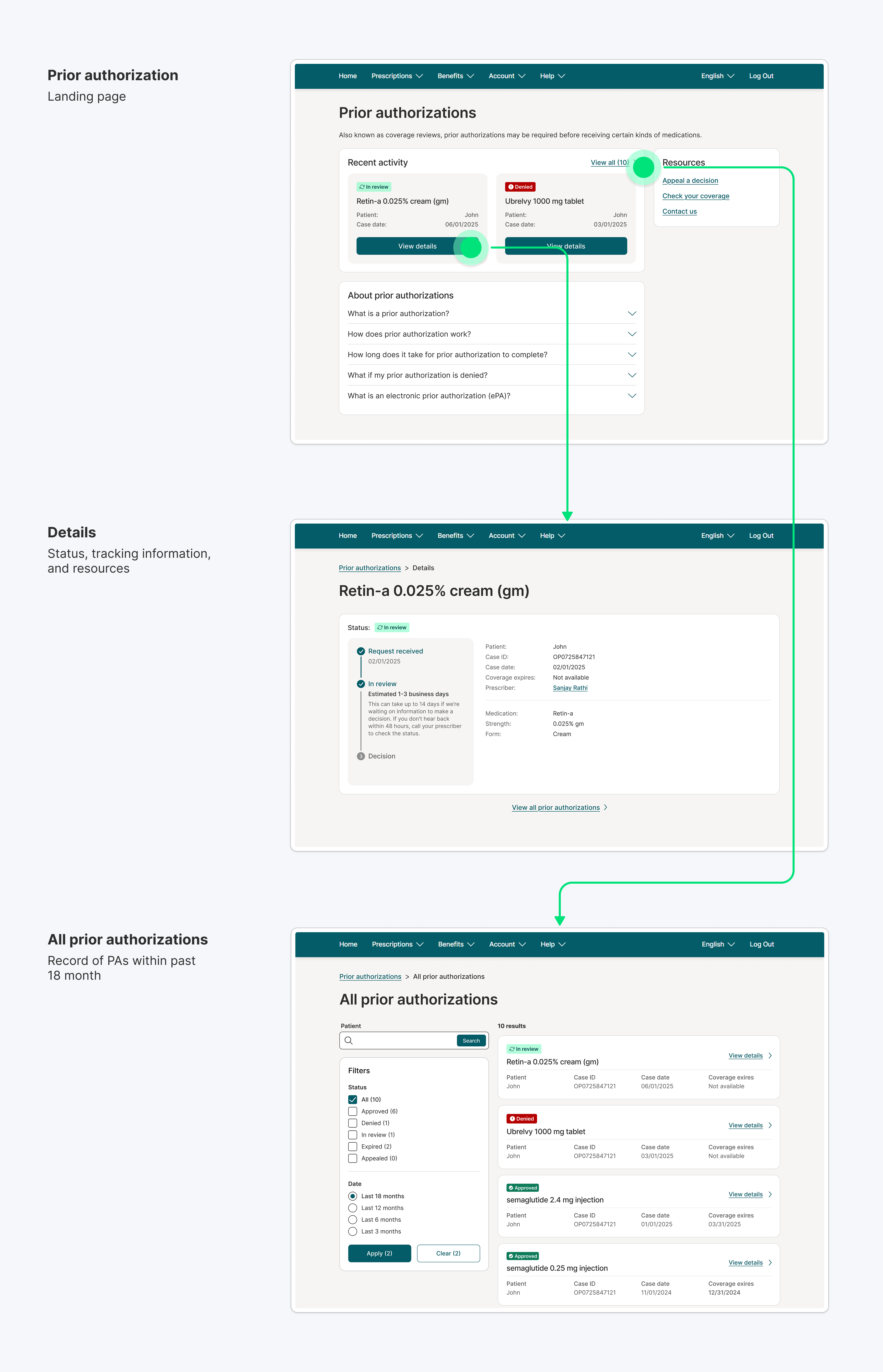
When a prior authorization was denied, members hit a dead-end. Based on the surprising research insights I gathered, I redesigned the denial experience, presenting the various courses of actions a member could consider in a denial situation. Data showed that most people wanted all available options, even if general, versus a single, personalized recommendation from their benefit plan. I embedded calls-to-actions wherever possible to enable a clear path forward for members.

"This is the best way to get bad news."
The quote above from a member captures what this work was really about. While prior authorization outcomes were largely outside of our control, what we could control was how members experienced them. My contributions to this massive effort led to changes towards a positive direction:
Members now receive immediate updates and notifications with real-time tracking, alerts and next steps, which minimize confusion and help prevent gaps in care.
5% decrease in negative sentiment, moving from a rate of 68% to 63%, a modest but expected shift.
10% engagement with new educational resources and next-step pathways that didn't exist before. This showed that members were finding and using the options I created for them.
A reported 5% drop in calls into the support center for denial decisions, which was an early sign that members were finding answers digitally rather than reaching for the phone.
I also designed keeping in mind flexibility and scalability as constraints. The patterns and workflows I delivered were built to support a future that could configure for both medical and pharmacy prior authorization lines of business.
Prior authorization is deeply rooted in policy and industry regulation. That wasn't going to change because of anything I designed, and I knew that going in to lead this work.
What kept me focused was believing that small wins still mattered. A member who could finally see their status, track it and understand how long the process would take, or find a clear next step after a denial was real progress in a system that offered very little of it. Fighting for those moments, in a process members didn't want or couldn't control, was the work worth doing.
What this reinforced for me is that meaningful design doesn't always announce itself. Sometimes it just quietly removes the thing that was getting in someone's way.