Cleared a financial barrier for members managing high-cost medications by designing a savings experience they could trust.


"I just can't afford it. I'll go weeks without my meds or spend too much time between websites comparing prices."
GLP-1 medications can cost $800 to $1,200 per month, even with insurance. Manufacturer savings cards existed to help, but members had no way to access them digitally. Knowing a savings card was even an option required knowing to ask, and using one meant calling in for support. The financial barrier was real. So was the access gap.
Why it mattered. For members managing diabetes or weight-related conditions, cost is directly tied to adherence. When medications become unaffordable, people stop taking them. The business had a contract with manufacturers and a home delivery pharmacy whose success depended on conversion. Solving the access gap meant better outcomes for members and better performance for the business.
The business came with a requirement already scoped and a signed contract in place. My job was to determine how the savings card experience would work end-to-end and whether it could work for members given known constraints.
Mapping the flow, I learned that adding a savings card during checkout didn't guarantee it would be applied through the adjudication service. A rejection after the order could leave a member with an unexpected bill.
I flagged the risk to stakeholders, advocated for a fix, and focused on designing the most responsible experience possible within those constraints.

82% of savings card additions happened at the medication list, not checkout. Research showed members wanted access to financial savings as early as possible, and I advocated for that placement over stakeholder preference for checkout only. Earlier in the flow, members were already reviewing their prescriptions and making decisions about their care. Evidently, it was the right moment.

"Applying" implied a success state the system couldn't guarantee. A card added during checkout could still be rejected after adjudication, leaving a member with an unexpected bill. Changing it to "adding" accurately reflected what was happening without creating a false promise at a moment of financial vulnerability. My content partner aligned on the change before we socialized it with stakeholders.

A rejected savings card after checkout meant an unexpected bill for a medication members thought they had saved on. I addressed the risk at multiple points in the flow.
Where field level validation was feasible, I pushed for it. Where it wasn't, I recommended specific language prompting members to double check their entries. I also included a consent checkbox confirming the two fields we couldn't validate matched members' savings cards.
Pricing disclaimers ensured members always knew what the price shown didn't include. This wasn't a perfect solution, but it was the most responsible one available given the constraints.

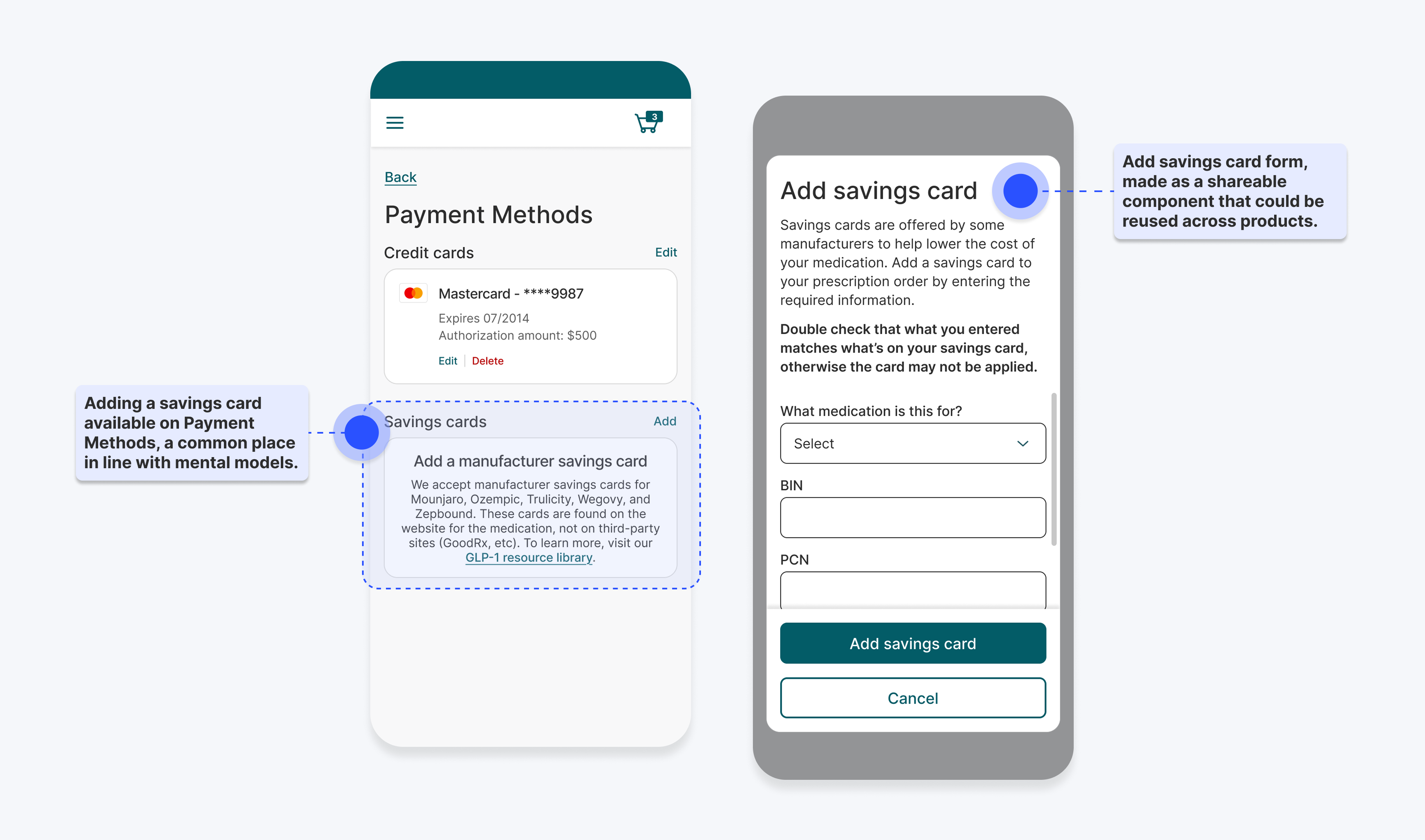
Active discussions around future savings capabilities shaped how I approached the work from the start. Rather than designing a localized GLP-1 specific solution, I built the savings card experience as a reusable capability that could plug into other product touchpoints across the wider ecosystem. For example, on Payment Methods was one touchpoint I identified for members who preferred managing savings cards outside the refill flow. The foundation was designed to extend wherever savings opportunities existed.

There's always a tension between what's ideal and what's possible. During this worktrack, knowing when to push and when to accept the constraint was a constant judgment call.
The technical limitations were real. The seamless experience members deserved wasn't possible within the constraints we faced. That was disappointing, but it pushed me to be more creative and more careful. I looked for every opportunity to reduce friction, set honest expectations, and give members a path forward even when the system couldn't guarantee the desired outcome.
That said, the solutions weren't perfect, but they were the most responsible ones available that I could advocate for and get built.